
Off-Road vs Street Legal Golf Carts in Austin TX: Which One Fits Your Lifestyle?
Not all golf carts are built for the same purpose, and the difference between an off-road build and a street legal configuration is more significant than most first-time buyers expect. A cart built for a ranch property outside Georgetown and one registered as a neighborhood vehicle in Lakeway look different, ride different, and are built with entirely different priorities in mind. Both are right choices in their respective contexts. The problem comes when a buyer picks the wrong one for how they actually plan to use it.
At Golf Carts of ATX, we work with buyers across both ends of this spectrum, from suburban homeowners who want a registered cart for daily neighborhood use to rural property owners who need something that can handle real terrain. The electric vs. gas question is one layer of this decision, but off-road vs. street legal runs deeper. Here's how to think through which direction actually fits your situation.
The Fundamental Difference Between the Two Configurations
A street legal golf cart is a registered Low Speed Vehicle that meets federal standard FMVSS 500 and can be operated on Texas roads posted at 35 mph or under. The design priority is road safety: the cart needs headlights, taillights, turn signals, brake lights, mirrors, seatbelts, a windshield, and a VIN. It's built to share residential streets with other vehicles, pedestrians, and cyclists.
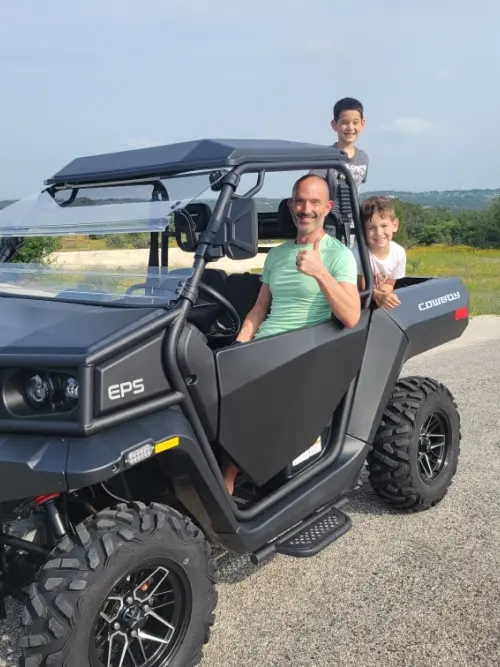
An off-road cart is configured for terrain performance, not road registration. Lift kits raise the frame height for ground clearance. Larger, aggressive tires provide grip on dirt, gravel, and uneven surfaces. These carts are built for real outdoor conditions including ranch roads, Hill Country property access paths, and rough terrain that would stop a standard cart. They're not registered for public roads and generally can't meet LSV equipment requirements in their off-road configuration. Understanding this difference from the start saves buyers from ending up with a build that doesn't match how they'll actually use the cart.
What Street Legal Requires in Texas
Getting a cart registered as a street legal LSV starts with the equipment list. Every required item has to be installed and functioning: headlights, taillights, brake lights, turn signals, reflectors, mirrors, seatbelts, and a windshield. The cart also needs a VIN and a top speed that falls between 20 and 25 mph. Once those are confirmed, registration at the Texas DMV costs $20.
Street legal carts tend to ride lower with smoother, road-appropriate tires. Large aggressive tires affect handling in suburban driving conditions, and since the clearance needed for off-road terrain isn't a priority on paved roads, the tire setup reflects that. We install complete street-legal light packages as part of new cart builds and as standalone upgrades for existing carts. If you want the full breakdown of what actually makes a cart road-legal in Austin, that guide covers every requirement in detail.
What Off-Road Carts Are Actually Built For
Off-road builds are for buyers whose primary need is terrain performance. Ranch owners, rural property managers, and buyers with large acreage are the most common customers for this configuration. A lift kit raises the cart's frame to clear obstacles and accommodate larger tires. The tires themselves are chosen for grip on loose, uneven, or soft ground rather than smooth tracking on pavement.
A popular combination in the Austin area is a moderately lifted cart paired with all-terrain tires, particularly for buyers with Hill Country property or large acreage east of the city. Among the most requested upgrades we see, lift kits paired with tire and wheel changes consistently rank at the top for property-use buyers. A well-built off-road cart covers ground reliably and requires less upkeep than the gas utility equipment it often replaces.
Which Configuration Makes More Sense for Austin Neighborhoods
For buyers living in golf-cart-friendly suburban communities such as Lakeway, Cedar Park subdivisions, or master-planned neighborhoods around Georgetown and Round Rock, the street legal build is the right call. The entire purpose is to drive on residential streets, which requires a registered LSV. An off-road configuration without LSV equipment can't be legally operated on public roads.
Neighborhood driving also calls for a different tire approach. All-terrain tires designed for off-road conditions wear faster on pavement and can feel unstable in certain suburban driving situations. If the primary use case is riding to a neighborhood pool, doing short errands, or getting kids to and from local activities, a street legal cart on appropriately sized road tires is what actually serves that purpose. Browse our shop to see configurations built specifically for this kind of everyday community use. New carts start at $3,995.
When One Cart Needs to Handle Both
Some buyers legitimately need a cart that works in both settings, and it's more common than it sounds. A suburban homeowner who also has a rural property, or someone who wants neighborhood access on weekdays and ranch use on weekends, faces this situation regularly. Building for both is possible, but it requires deliberate trade-offs.
The tire and wheel builder on our site is a useful starting point for thinking through what a hybrid setup looks like. A moderate lift with all-terrain tires that still perform acceptably on pavement is the most practical middle-ground solution. Extreme off-road builds with very high lifts and very large tires don't translate well to paved roads. A well-considered moderate setup handles both situations reasonably well. It won't be the ultimate version of either configuration, but for buyers who genuinely need both, it's a practical answer.
How We Help You Get the Right Build
Whether you're building a street legal neighborhood cart, a property off-road vehicle, or something that sits between those two, our team has built all of it. We handle everything from initial equipment installs to full custom builds, including lift kits, light packages, tire and wheel combinations, and sound systems. We also run mobile repair and service across Austin, Georgetown, Round Rock, Dripping Springs, Lakeway, Pflugerville, Cedar Park, and San Marcos, servicing E-Z-GO, Club Car, Yamaha, ICON, Evolution, and Coleman Powersports carts regardless of where they were purchased.
If you're still working through this decision, come by the showroom or reach out through the website. The right cart is the one that matches how you'll actually use it, and that's a conversation worth having before you spend money on a build that doesn't fit.